20 Hands on STEM Projects Kids Will Love to Try?

Engaging children in learning can be a joyful journey when incorporating hands on STEM projects. These activities ignite curiosity and provide practical experiences in science, technology, engineering, and mathematics. Children thrive when they can interact, explore, and create.

Hands on STEM projects allow kids to experiment, make mistakes, and refine their understanding. For example, building a simple robot can teach principles of engineering and coding while sparking creativity. Not every project will go as planned; some may fail, and that’s part of the learning process.

Encouraging kids to think critically and solve problems is essential. With hands on STEM projects, children develop skills that will benefit them in the future. As they engage with these activities, they learn persistence and resilience. Mistakes lead to valuable insights, shaping their approach to challenges. Each project opened doors to a better understanding of the world around them.

20 Hands on STEM Projects Kids Will Love to Try?

Introduction to STEM Projects for Kids

STEM projects provide a wonderful introduction to science, technology, engineering, and math for kids. These areas spark curiosity and creativity. Engaging in hands-on activities can deepen understanding and retention of complex concepts. Kids learn best when they can see and touch what they are studying. For example, building a simple circuit can illustrate electrical principles effectively.

Experimentation is a key aspect of STEM education. Children are encouraged to ask questions and find solutions through trial and error. They might face challenges while working on projects. Perhaps their bridge design collapses during testing, or their chemical reaction doesn’t yield the expected results. These moments foster critical thinking and resilience. It’s essential for kids to learn that failure is part of the learning process. This builds character and encourages a growth mindset.

Hands-on projects can be as simple as creating a volcano with baking soda and vinegar. This project teaches kids about chemical reactions. More complex tasks, like constructing a robot using household items, involve engineering skills and problem-solving. Whichever project they choose, the experience is invaluable. Kids not only gain knowledge but also develop essential life skills.
20 Hands-on STEM Projects Kids Will Love to Try

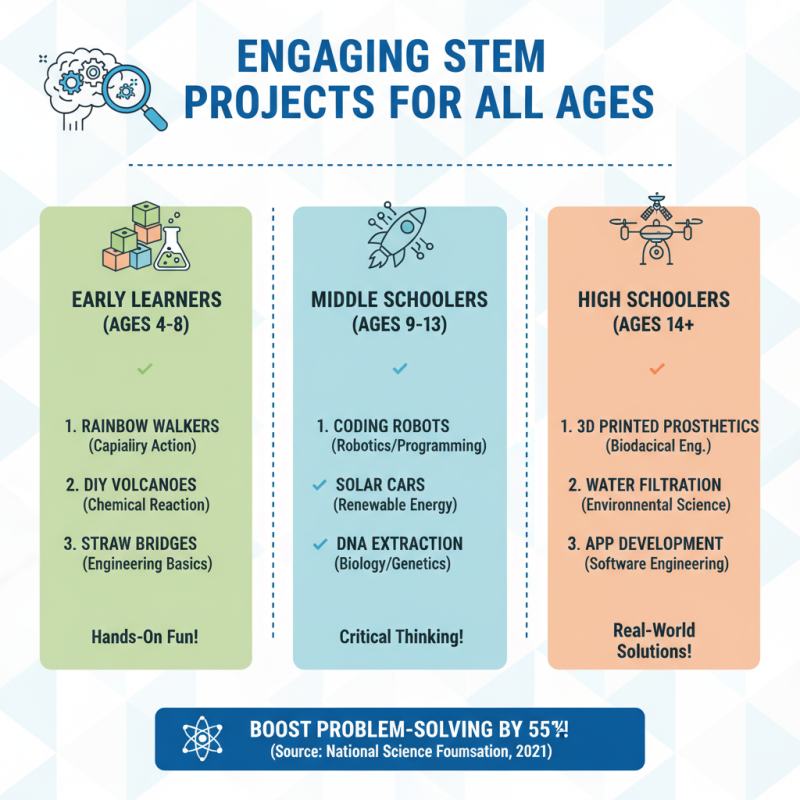
This chart displays the number of kids who expressed interest in different STEM project categories. Each project category shows a variety of engaging activities that kids can explore to enhance their understanding of science, technology, engineering, and mathematics.

Benefits of Hands-On Learning in STEM Education

Hands-on learning is vital in STEM education. It actively engages children, fostering creativity and innovation. When kids build, experiment, or create, they learn by doing. This approach enhances their problem-solving skills and deepens their understanding of complex concepts. Through practical experiences, students connect theories to real-world applications.

Moreover, hands-on projects cultivate teamwork and communication skills. Children learn to collaborate and share ideas. They face challenges together, developing resilience. Even when a project fails, it offers valuable lessons. This reflection process encourages critical thinking. Kids begin to doubt less and experiment more, fostering a growth mindset, essential for lifelong learning.

Involving students in STEM projects sparks curiosity. They become eager to explore and discover. This intrinsic motivation drives their interest in science and technology. Real-world challenges present opportunities for creativity. Children can design solutions, expanding their thinking beyond textbook knowledge. The tangible results from their efforts build confidence, promoting a positive attitude towards learning.

20 Hands on STEM Projects Kids Will Love to Try

Project Title Age Group Materials Needed Learning Outcome
DIY Slime 5-10 Glue, Baking Soda, Contact Lens Solution Understanding chemical reactions
Volcano Eruption 6-12 Baking Soda, Vinegar, Food Coloring Learning about acid-base reactions
Egg Drop Challenge 8-15 Egg, Straws, Tape, Cotton Balls Principles of physics and engineering design
Mini Catapult 7-13 Popsicle Sticks, Rubber Bands, Spoon Understanding force and motion
Bridge Building 10-16 Straws, Tape, Weights Learning about load distribution and engineering
Water Filtration 9-14 Sand, Gravel, Activated Charcoal, Filter Paper Understanding water purification techniques
Lemon Battery 10-15 Lemons, Copper Coin, Zinc Nail, Wires Basics of electrical circuits
Robot Hand 8-13 Cardboard, Straws, String Basics of robotics and motion
Solar Oven 9-14 Pizza Box, Aluminum Foil, Plastic Wrap Understanding solar energy
Marshmallow Tower 8-12 Marshmallows, Toothpicks Principles of structure and stability
Circuit Straw 7-12 Straws, LED, Battery Basics of electric circuits
Bubble Science 6-11 Dish Soap, Water, Glycerin Understanding surface tension
Paper Rockets 8-14 Paper, Scissors, Tape, Straw Learning about aerodynamics
Shadow Puppets 5-10 Cardboard, Light Source Understanding light and shadow
Pendulum Wave 10-15 String, Weights, Rods Understanding wave motion and frequency
Hydraulic Lift 9-15 Plastic Syringes, Tubing, Water Learning about hydraulics and force
Balancing Act 7-12 Wood, Weights Understanding balance and center of gravity
Windmill Power 9-16 Paper, Straws, Small Generator Understanding wind energy and conversion

List of Engaging STEM Projects for Different Age Groups

20 Hands on STEM Projects Kids Will Love to Try?

STEM projects ignite curiosity in kids. They encourage hands-on learning and critical thinking. A study by the National Science Foundation (2021) highlights that engaging STEM activities boost problem-solving skills by 55%. Age-appropriate projects are key to effective learning.

For younger children, simple projects like creating a homemade volcano can captivate their imagination. At the same time, older kids could explore building a basic robot. Engaging activities appeal to different age groups, providing unique challenges. According to research from the American Association for the Advancement of Science, kids in grades K-5 show a 70% increase in interest in science after participating in interactive projects.

While these projects are fun, they may include hurdles. Younger children might struggle with complex instructions. Older kids may become frustrated with technical difficulties. It's important to recognize these challenges. Adjusting projects to fit the skill level enhances learning and enjoyment. Balancing engagement and capability is crucial for success in STEM education.

Step-By-Step Instructions for Each Project

STEM projects ignite curiosity and creativity in kids. Hands-on activities not only teach scientific concepts but also foster problem-solving skills. Each project listed comes with clear, step-by-step instructions to guide young explorers through the process. Starting with simple materials, kids can create engaging experiments that result in tangible outcomes.

Take the classic volcano project. It involves baking soda, vinegar, and colorful food dye. Mixing these ingredients produces a fun eruption. Supervision might be required, as this project can get messy. However, the excitement of watching a mini eruption teaches basic chemical reactions. Kids learn about cause and effect while having fun.

Another engaging activity is building a simple circuit. Using a battery, wires, and a light bulb, children can see electricity in action. The project may not work perfectly on the first try. This allows for reflection on what went wrong. Encouraging kids to troubleshoot helps them develop critical thinking. Each hands-on project in this guide offers a unique learning opportunity, making science enjoyable and memorable.

Tips for Parents to Facilitate STEM Learning at Home

20 Hands on STEM Projects Kids Will Love to Try?

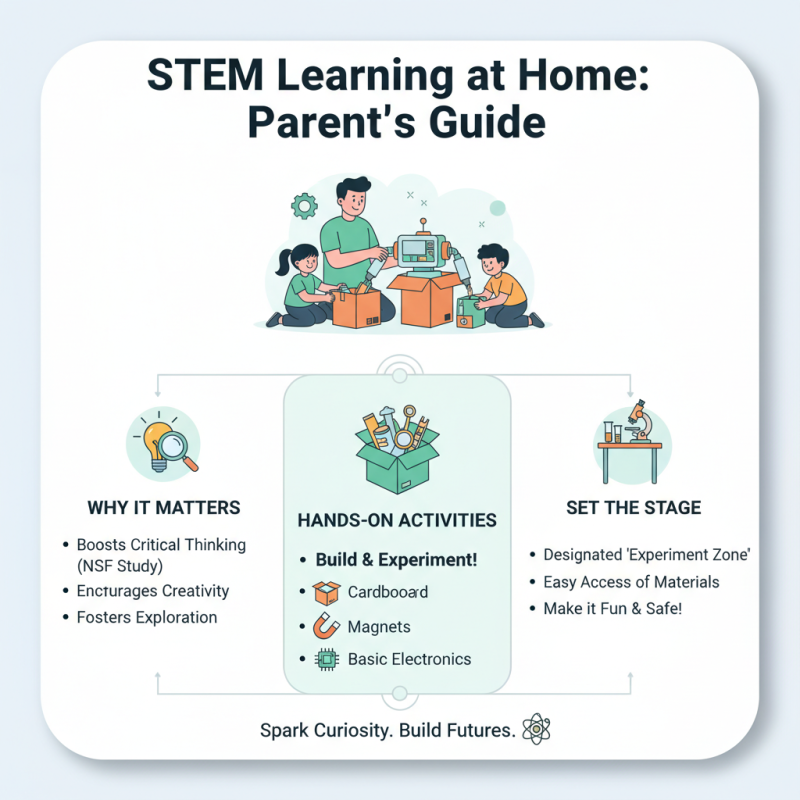
Facilitating STEM learning at home can be a rewarding experience for parents and children. A recent study by the National Science Foundation reveals that engaging in hands-on STEM activities boosts children’s critical thinking skills. Parents can create a learning environment rich with resources. Simple materials like cardboard, magnets, and basic electronics can spark interest. Set up a designated space for experiments to encourage creativity and exploration.

Effective communication is key. Discuss experiments before starting and ask open-ended questions during the process. This promotes deeper understanding and critical skill development. A report from the American Association for the Advancement of Science highlights that children learn best through questioning and inquiry. Keep safety in mind. Some projects may require supervision. Engage with your child’s ideas, even if they deviate from the expected outcomes.

Remember, not every project will succeed. This is a learning opportunity. Reflecting on challenges helps develop resilience in children. Encouraging persistence is vital. Recognizing failure as part of the learning process cultivates a growth mindset. By creating a supportive atmosphere, parents can foster a love for learning and exploration that lasts a lifetime.